Does Red Light Therapy Really Work?
Does Red Light Therapy Really Work? What the Research Says
Red light therapy has gone from a relatively specialist technology to something increasingly found in clinics, gyms, beauty studios and homes.
But with so many wellness trends making impressive promises, it is reasonable to ask:
Is there actually any scientific research behind red light therapy?
The short answer is yes.
Red and near-infrared light have been investigated in clinical trials and systematic reviews under terms including photobiomodulation (PBM), low-level light therapy (LLLT) and LED phototherapy.
The research doesn't mean that every red light device will produce the same result, or that red light therapy should be considered a cure or medical treatment. Wavelength, intensity, treatment time and the distance between the light and the body can all influence the amount of light delivered.
However, there is genuine peer-reviewed research behind the technology.
What is photobiomodulation?
Photobiomodulation involves exposing the body to particular wavelengths of visible red or near-infrared light.
Unlike ultraviolet light, the wavelengths normally used in red light therapy do not work by tanning or deliberately damaging the skin.
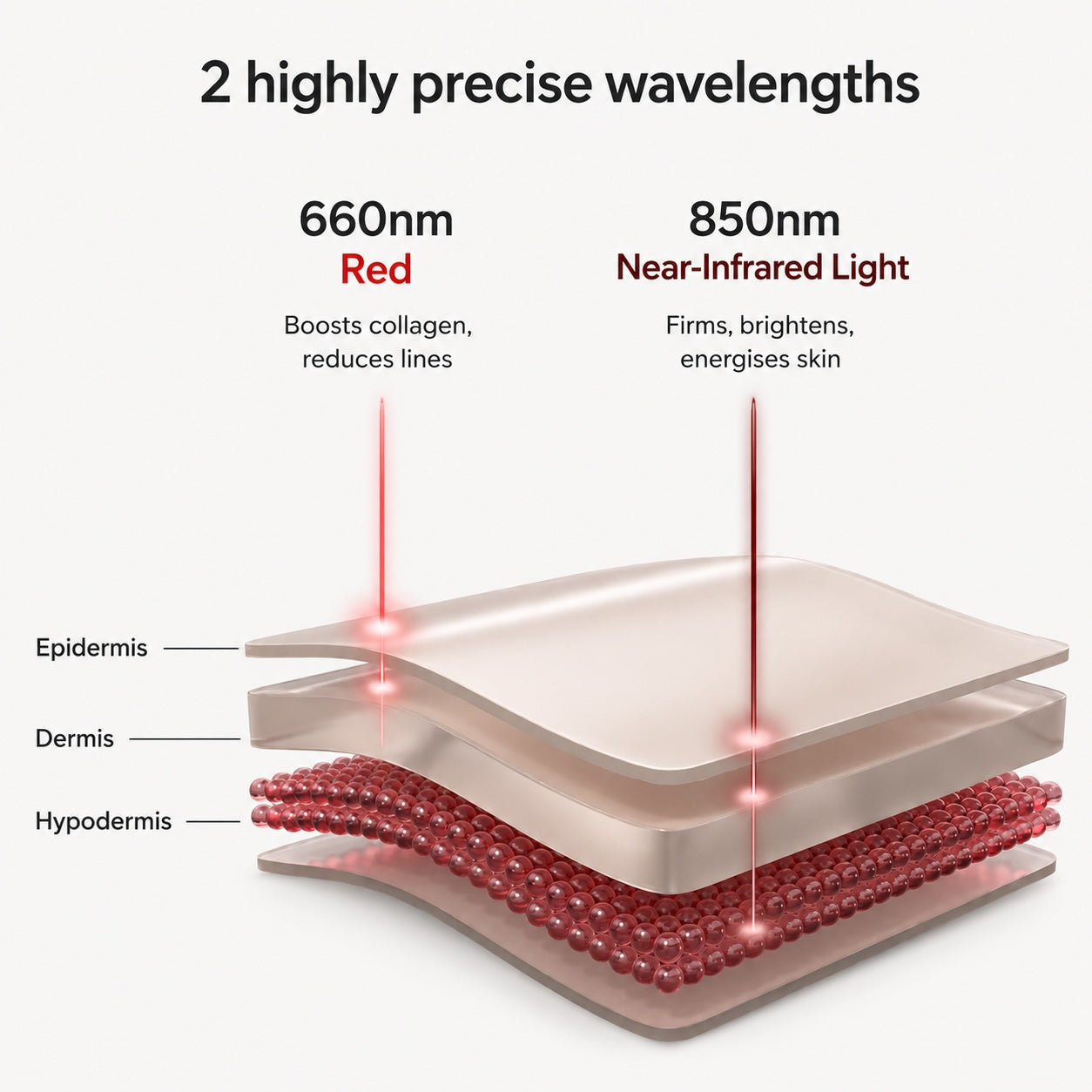
Red and near-infrared wavelengths behave differently because different wavelengths penetrate tissue to different depths. This is one reason many modern red light therapy panels combine the two.
The Vital Earth Restore 400, for example, uses:
660nm visible red light
and
850nm near-infrared light
These exact specifications should not be confused with the devices used in every published study, but they sit within the red and near-infrared ranges commonly investigated in photobiomodulation research.
What has research found about red light and skin?
Skin appearance is one of the better-known areas of red light research.
A clinical trial published in the Journal of Cosmetic and Laser Therapy investigated a combination of 633nm red light and 830nm near-infrared light.
Thirty-one participants received nine LED light sessions.
At the follow-up, researchers reported measurable changes in skin-surface assessments. They reported that 52% of participants showed a 25–50% improvement in photoageing scores and 81% reported improvement in the appearance of wrinkles around the eyes.
The researchers concluded that combined red and near-infrared LED therapy represented an effective and acceptable approach to photo-rejuvenation, while also noting that further research was required to optimise treatment parameters.
Another controlled study produced interesting results
A separate prospective, randomised, placebo-controlled and double-blinded study investigated LED phototherapy using 633nm and 830nm wavelengths.
Researchers reported significant reductions in measured wrinkles and increases in skin elasticity compared with baseline measurements. Examination of skin samples also found changes involving collagen and elastic fibres.
Importantly, the treatment was reported as being well tolerated by the participants.
These studies don't mean that every red light device will produce identical changes. They do, however, demonstrate why red and near-infrared wavelengths have attracted so much interest within skin and beauty research.

What about exercise and recovery?
Red and near-infrared photobiomodulation have also been studied in relation to exercise.
Rather than relying on a single small trial, researchers have conducted systematic reviews examining multiple randomised controlled trials.
One systematic review and meta-analysis published in Lasers in Medical Science looked at research involving low-level laser and LED phototherapy before, during or after exercise.
Researchers identified 13 randomised controlled trials that met their methodological quality requirements.
Of the trials applying phototherapy before exercise, most reported improvements in their main performance measurements.
Across the analysed research, the authors found statistically significant improvements in measures such as time to exhaustion and number of repetitions compared with placebo treatment.
The authors concluded that phototherapy using laser or LED light showed potential for improving muscular performance and exercise recovery, particularly when used before exercise.
View the systematic review on PubMed
Again, this doesn't mean that sitting in front of any red light automatically produces faster recovery.
The studies used specific doses, wavelengths and treatment protocols. But they demonstrate that photobiomodulation and exercise recovery are subjects of genuine scientific investigation rather than simply marketing concepts.
Why do red light devices use more than one wavelength?
There isn't one universally “best” wavelength for every purpose.
Different studies have used different wavelengths, including those around:
630–660nm in the visible red range
and
810–850nm in the near-infrared range
This is why dual-wavelength panels have become popular.
The Restore 400 combines 660nm red light with 850nm near-infrared light, allowing both wavelength ranges to be used during one convenient session.

Near-infrared light is largely invisible to the human eye, so don't be concerned if the 850nm LEDs do not appear as bright as the visible red LEDs. They can still be emitting light even though you cannot see it in the same way.
So, does red light therapy work?
Perhaps the most accurate answer is:
There is credible scientific evidence that red and near-infrared photobiomodulation can produce measurable biological effects, but outcomes depend heavily on how the light is delivered.
That distinction matters.
Red light therapy should not be presented as a miracle cure, and consumers should be cautious about products promising dramatic or guaranteed results.
At the same time, dismissing the entire field as simply another internet wellness trend ignores a substantial body of published research.
Clinical trials have investigated red and near-infrared light in areas including skin appearance and photobiomodulation around exercise, while continuing research is investigating many other applications.
For us, that's one of the most interesting things about red light therapy.
It is simple enough to use at home, but the technology behind it is being actively studied by researchers around the world.
Bringing Red Light Therapy Home
The Vital Earth Restore 400 Red & Near-Infrared Light Therapy Panel has been designed to make red light sessions straightforward at home.
It combines:
660nm red light + 850nm near-infrared light
80 high-performance LEDs
Adjustable digital timer
Compact tabletop design
UK power supply
2-year manufacturer warranty
There are no complicated routines required. Position the panel at the recommended distance, select your session time and make it part of your normal wellness routine.
Discover the Vital Earth Restore 400 →
A sensible perspective
Research into photobiomodulation continues to develop, and different studies use different wavelengths, intensities and treatment protocols.
The studies referenced in this article investigated photobiomodulation generally and did not test the Vital Earth Restore 400 specifically. Individual experiences can therefore vary.
Red light therapy products sold by The Vital Earth are intended for general wellness use and are not intended to diagnose, treat, cure or prevent disease.
Research referenced
Russell BA, Kellett N, Reilly LR.
A study to determine the efficacy of combination LED light therapy (633 nm and 830 nm) in facial skin rejuvenation. Journal of Cosmetic and Laser Therapy, 2005.
PubMed study
Lee SY et al.
A prospective, randomized, placebo-controlled, double-blinded, and split-face clinical study on LED phototherapy for skin rejuvenation.
PubMed study
Leal-Junior ECP et al.
Effect of phototherapy (low-level laser therapy and light-emitting diode therapy) on exercise performance and markers of exercise recovery: a systematic review with meta-analysis. Lasers in Medical Science.
PubMed review